


Adriatic Strike 2025

Report and photos by Robin Polderman
Last June, The Unit Report travelled to beautiful Slovenia to learn more about the 12th edition of Adriatic Strike, an exercise hosted by the Slovenian Armed Forces and primarily, but not exclusively, focused on realistic Joint Terminal Attack Controller (JTAC) training.
The Slovenian Armed Forces Air Ground Operations School, which organizes the Adriatic Strike exercise, has established itself as one of Europe’s leading JTAC expertise centers.
A JTAC is often described as ‘a qualified military service member who directs combat aircraft in close air support and other offensive air operations from a forward position, serving as a critical link between ground forces and the air assets they support.’
However, there is more to JTAC than meets the eye!
JTACs also serve in an advisory role for the commander in the field on the correct use of air, naval, mortar or artillery fire support. Besides their obvious Close Air Support role, they can be tasked with reconnoitring routes, escorting convoys and monitoring the surrounding area, ensuring comprehensive protection for allied forces.
A JTAC is useful in the civil arena as well; they played a very important role in extinguishing forest fires in Slovenia’s Karst region. They were also active during extensive flooding in the country, when JTACs ensured the safe and effective execution of air operations in support of the civilian population.

In the past, JTACs were referred to as Forward Air Controller (FAC). Warfare has evolved, and the new name for FAC became JTAC to reflect the broader spectrum of tasks performed. A JTAC is no longer exclusively an aviator but often has a different military background, its tasks bordering on those performed by Special Forces.
Besides catering for JTACs, the Adriatic Strike exercise provides realistic and complex training for a wide variety of personnel involved, including air crews, commanders up to Division level, UAV pilots and Special Forces, to name but a few.
The 2025 edition of Adriatic Strike saw the participation of 800 personnel from a staggering 31 countries (Australia, Austria, Belgium, Bosnia-Herzegovina, Canada, Croatia, Czech Republic, Denmark, Estonia, Finland, France, Germany, Greece, Hungary, Italy, Latvia, Lithuania, Montenegro, Netherlands, North Macedonia, Norway, Poland, Romania, Slovakia, Slovenia, Spain, Sweden, Switzerland, Turkey, United Kingdom and the United States).

A total of ten countries sent helicopters and fixed-wing aircraft to Slovenia for the exercise. The Slovenian air base of Cerklje ob Krki functioned as the Main Operating Base for aircraft participating. Located close to the border with Croatia, the base housed a regiment flying Jastreb and Orao fighter aircraft up until 1991, when Slovenia became independent from the Yugoslav Federation. In the past 30+ years, the base was extensively modernized, becoming the main hub for Slovenia’s small air force, and an important NATO-base in Central Europe.
The airfield features ample ramp space, enough to house a few squadron of fighters if need be, and is perfectly suited to host the exercise.
The following air assets participated in the Adriatic Strike exercise:
-Austria PC-7 (from home base Zeltweg)
-Croatia PC-9M (from home base Zadar) & OH-58D
-France Mirage 2000D
-Italy Eurofighter F-2000A (from home base)
-Montenegro Bell 505 & Bell 412Epi
-Spain EC665 Tiger & CH-47F
-Turkey CN235
-United States F-16C/D (from home base Aviano) & C-130J-30 (from home base Ramstein)

Several civilian operated aircraft also participated (German Learjet and PC-9, Dutch L-39C Albatros). The home team participated in Adriatic Strike with among others, the AS532AL Cougar, Bell 206B, Bell 412SP/EP and PC-9M.
Unmanned Aerial Vehicles (UAV) were also extensively used, with seven NATO nations utilizing these during Adriatic Strike.
Operations were conducted in five exercise areas scattered around Slovenia with each area providing a specific type of training.
Training Area 1 was located around Kočevje/Ribnica and focused on combat decision-making from command posts, which came under regular simulated attacks from Opposing Forces (OpFor).
Training Area 2 (Poček) was used by JTACs to coordinate cargo drops from both rotary- and fixed wing aircraft. They made use of newly acquired digital communication equipment immune to electronic interference.
Training Area 3 (Kamnik-Savinja Alps) was used to direct Close Air Support missions in mountainous terrain, along with personnel recovery in a CSAR scenario.
Training Area 4 (Slovenj Gradec) was used to direct cargo drops, parachute jumps while capturing a simulated enemy airfield. Participants were also subjected to trench- and bunker warfare in this training area.
Training Area 5 (Cerklje ob Krki air base) focused on Division-level training with an emphasis on the Joint Air Ground Integration Cell (JAGIC). Participants used five JTAC simulators in computer based scenarios using the latest virtual technology.
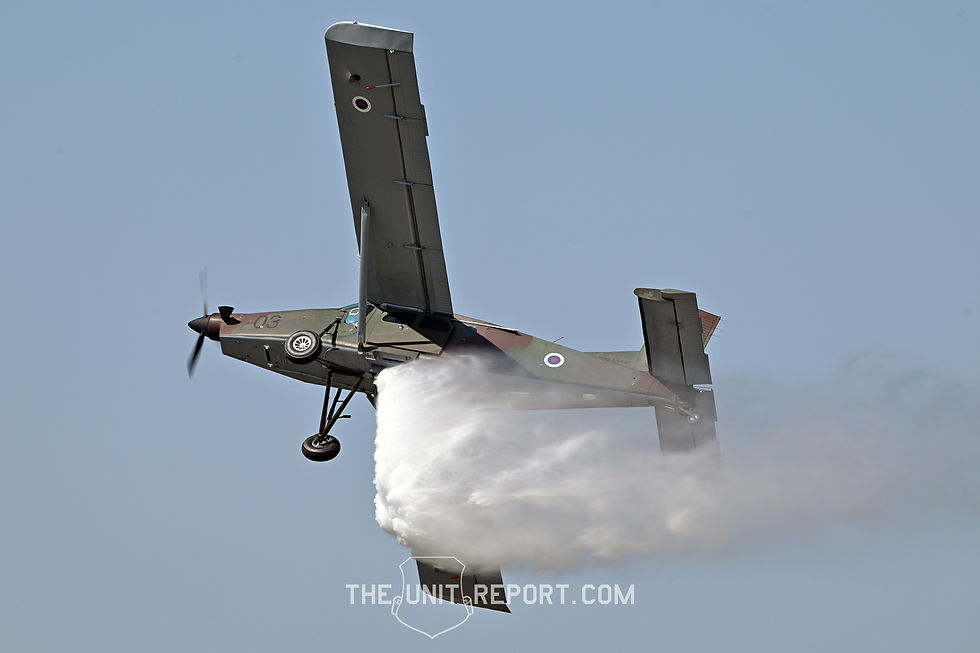
To showcase both the air- and ground assets participating in Adriatic Strike, an Open Day at Cerklje ob Krki was staged for Saturday 14 June.
Most participating aircraft and helicopters that had deployed to Cerklje for the exercise flew a short demonstration routine.
Besides the flying and static exhibition, visitors to the Open Day were also treated to a military ceremony, which marked the beginning of the exercise.
Those who took the trouble of travelling to Cerklje ob Krki were treated to a day of glorious sunshine at this well organized event.
Many thanks to the Slovenian MoD for the possibility to visit Adriatic Strike.


