


Out with the old, in with the new!

Report and photos by Robin Polderman
When visiting the Hungarian air base of Szolnok, one can not overlook the many disused Mi-8/17 and Mi-24 helicopters dotted around the various dispersals at the southern end of the base; a memory of days gone by. Not a distant memory however, as the process of phasing out old Hip and Hind helicopters of Soviet origin and gradually replacing them with a fleet of modern Airbus helicopters started only in 2018. The infrastructure of the MH Kiss József 86. Helikopterdandár (Hungarian Defense Forces 86th Helicopter Brigade - József Kiss*) has gone trough a remarkable transformation as well, with the establishment of a new 115.000 sq.m maintenance facility, enough to house all the based helicopters, along with a new ramp big enough for 18 rotorcraft.
Over the past decade, Hungary has embarked on a momentous journey towards modernization of its armed forces, quite possibly the most significant upgrade in Central Europe. These investments were done not only to get rid of outdated equipment, mostly of Soviet origin, and enhance the capabilities of the Hungarian Military, but also to achieve a higher level of interoperability with fellow NATO forces.
Besides housing Hungary’s brand new helicopter fleet, the Brigade is also responsible for the elementary flying training of student pilots.
The author, assisted by Arno Kok and Micha Lievers, travelled to Szolnok air base to find out more.
Training pilots
All basic education of Hungary’s military officers is provided by the Ludovika University of Public Service in Budapest, where the Faculty of Military Sciences and Officer Training trains cadets in the field of infantry, armour, artillery, reconnaissance, maintenance, logistics, military engineering, signalling, nuclear/chemical/biological warfare, aviation and air defence.

Officer cadets destined to become pilots transfer to the university’s Szolnok campus for the flying part of their education, starting in their third year at the university.
For the purpose of flight training, eight Czech-build Zlin aircraft are in use. Four of these (two Zlin 242L and two Zlin 143LSi) were delivered in 2018, with another four Zlin 242L received in late 2020. The main difference between the Zlin 143 and 242 is the number of seats; the 143 has four, while the 242 is a pure trainer with only two seats. The aircraft were purchased to replace the obsolete fleet of twelve Aerostar Iak-52 aircraft, purchased in 1993.
The training syllabus includes basic flight manoeuvres, basic IF flying and formation flying, besides shooting many approaches using Szolnok’s 02/20 runway. Following a total of 25 flight hours on the Zlin, instructors have a clear picture of a student’s abilities and which aircraft would suit them best.
Pilots destined to fly fixed wing will complete so-called Phase II and III training in the USA, using the T-6A Texan II and T-38C Talon. Phase IV will consists of training with the International Flight Training School (IFTS) at Decimomannu in Italy, utilizing the Leonardo T-346A. Currently, the Hungarian Air Force is setting up its own training using brand new L-39NG aircraft, delivered during 2025 and 2026.
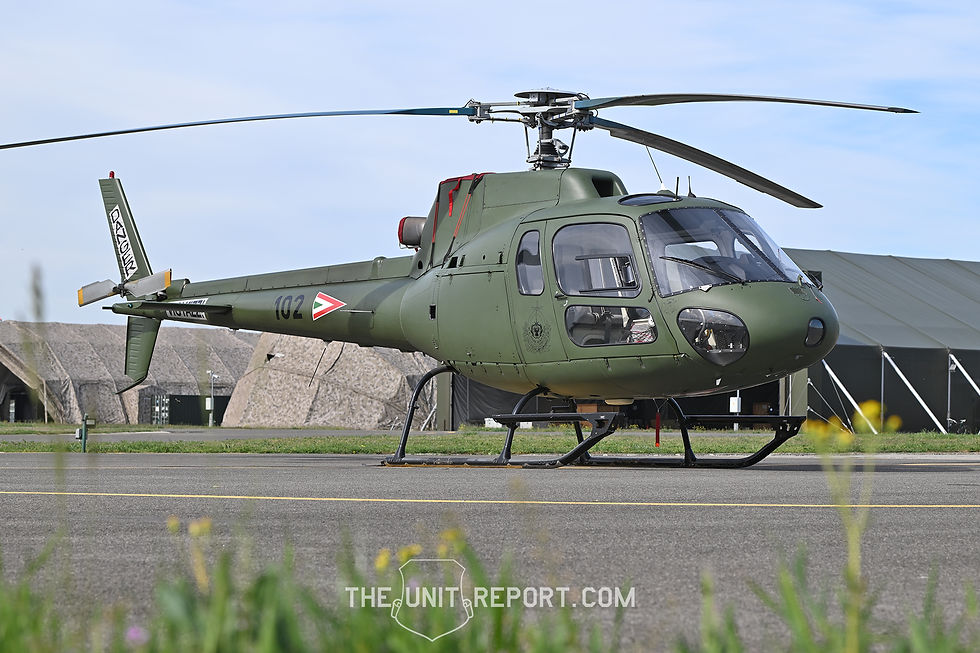
Future helicopter pilots will fly the AS350B2 Ecureil, two of which are in service at Szolnok. Both were in use as civil ambulance helicopter in Hungary since 1991, before being obtained by the air force in May of 2016. Since the type is not equipped with any modern stabilization or autopilot systems, unlike the new modern fleet in use, student pilots learn the very basics of helicopter flying.
Currently most helicopter student pilots transfer to Fort Rucker in Alabama after flying 20 hours on the AS350B2. Here they undergo Initial Entry Rotary Wing (IERW) training using the UH-72 Lakota fleet of the US Army’s Aviation Center of Excellence.
Pilots who remain in Hungary for further training clock 40 flight hours on the AS350B2 before embarking on a H145M or H225M conversion course, also at Szolnok.
Renewal incoming
In June of 2018 Hungary ordered 20 Airbus H145M helicopters. The contract also included the training of 50 pilots and 70 technicians at the Airbus facility in Donauwörth. These light multipurpose helicopters can perform a wide range of tasks, including troop transport, utility, surveillance, SAR, armed reconnaissance and medical evacuation. The Hungarian fleet is equipped with a fast roping system, high performance camera, fire support equipment, ballistic protection as well as an electronic countermeasures system.
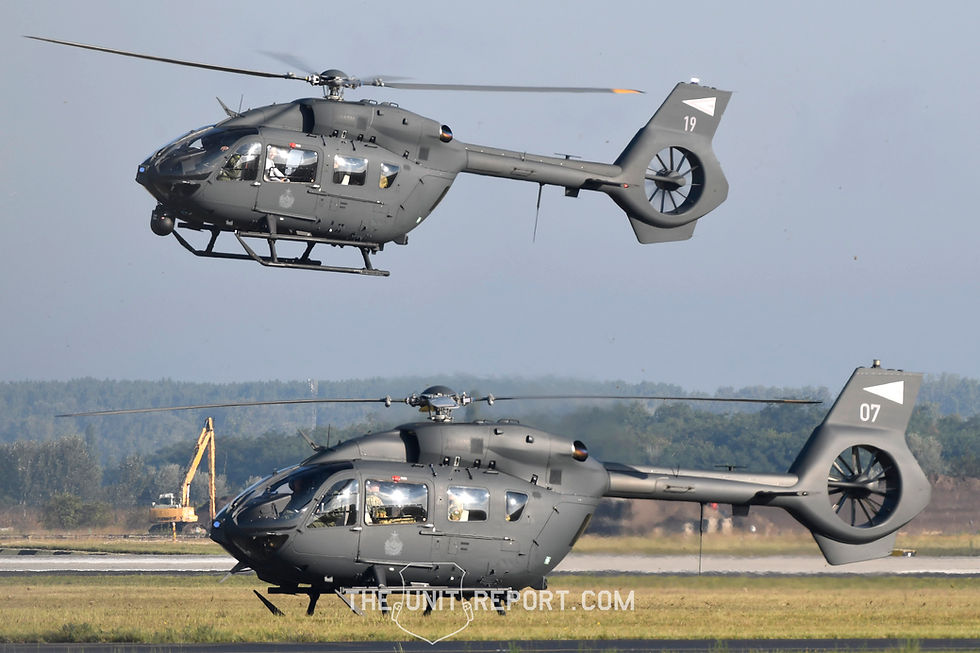
The H145M can be fitted with the HForce weapon management system, which allows the external mounting of various weapons on a weapon pylon. These weapons include the 12-tube Thales FZ231 rocket pods, capable of firing both 2,75” (70 mm) unguided ballistic rockets as well as laser-guided precision rockets.
Two types of gun pods can be used; the FN Herstal HMP400 12.7 mm pod or the Nexter NC621 carrying a 20 mm cannon and 180 rounds of ammunition.
With one having been lost in an accident in Croatia in June of 2023, nineteen H145Ms continue their service in the Hungarian Air Force.
On 14 December 2018, Airbus and the Hungarian Government announced they had signed a contract for the delivery of 16 Airbus H225M helicopters to the Hungarian Air Force. With this order, Hungary became the ninth country which selected the H225M for its needs.
Airbus provided theoretical training for 20 pilots and ten flight engineers at the company’s Training Academy in Marseille-Marignane, starting in March of 2023. Of this group, two pilots and two flight engineers received flight training at an Airbus facility, the remainder of the group converted to the H225M at Szolnok under the wings of Airbus flight instructors.
By now, the Hungarian Air Force has taken over training and built a complete syllabus in-house, from type rating for new pilots to tactical flight training for the more experienced aviators.
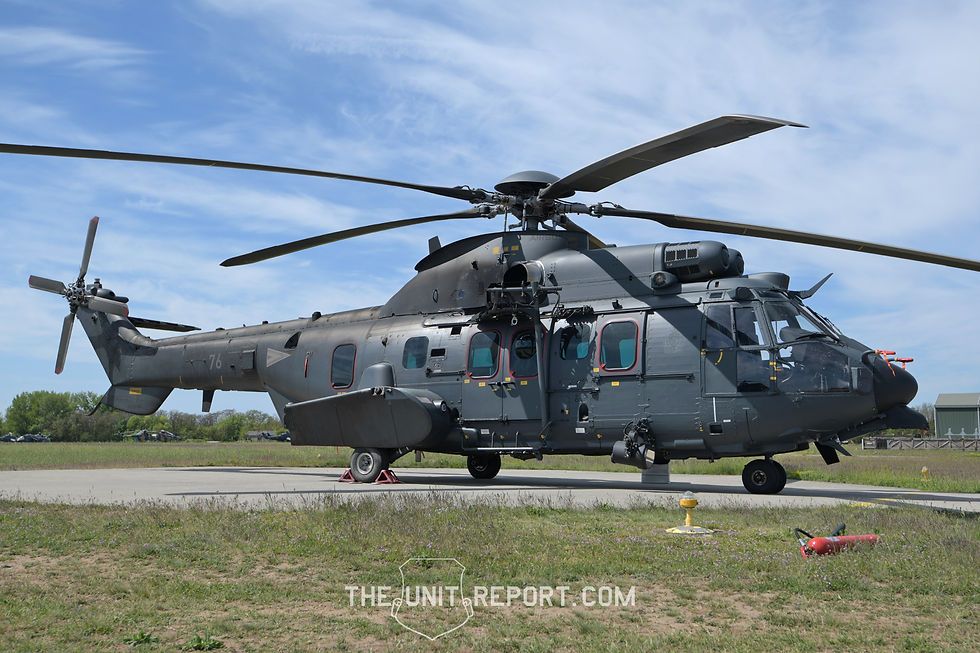
On 24 July 2023, the first pair of H225M helicopters was ceremoniously handed over to the Hungarian Air Force at Szolnok. Subsequent deliveries proceeded at a steady stage and saw the last pair arrive in Hungary on 15 July 2025.
For the Hungarians, the H225M is used as the ‘Swiss Army knife of helicopters’, with the type not only providing airlift capabilities for troops or cargo, but being also suitable for SAR, MedEvac and fire fighting. Its combat role sees the H225M being used as Close Air Support or Close Combat Attack helicopter.
Out of the 16 helicopters delivered, six are used as a special operations platform, which includes the HForce weapon management system also in use on the H145M.
During The Unit Report’s visit to Szolnok, the first H225M to have reached 600 flighthours was undergoing inspection inside the brand new maintenance facility. The unit at Szolnok performs all 300- and 600 hours inspections on its helicopters in-house, with none of the aircraft needing to fly abroad for maintenance.
During May of 2026, the remaining Mi-17 passed the baton of SAR service over to the H225M. To provide 24/7 SAR coverage for the whole of Hungary, a small detachment using either the H145M or H225M is stationed at the airbase of Pápa, in the western part of the country. This detachment is responsible for SAR west of the Danube, while helicopters at Szolnok cover the part east of the river.
Earlier, in the beginning of 2026, the Mi-24 fleet was grounded and put in reserve. During a ceremony at Szolnok on 18 June 2026, the Hungarian Air Force bid farewell to both the Mi-17 and Mi-24 helicopters.
With the drawdown of the Soviet-origin helicopter fleet, the NATO-mission in Kosovo (to which Hungary contributes with an in-theatre air force element) and the EUFOR Althea mission in Bosnia and Herzegovina (for which an element is in readiness mode at Szolnok) will now be fulfilled by the H145M and H225M.

A shift in culture
Szolnok has witnessed a shift in rotary-wing culture, with the transition from helicopters developed 60 years ago to new rotorcraft from the digital era. Nowadays, the operational environment is digital and any helicopter that doesnot have the hardware architecture to receive and process digital information is considered obsolete.
The biggest challenge for pilots converting to the new types from the older Soviet types was not the flying itself, since most of them are seasoned veterans with plenty of flight hours under the belt, but the managing of state-of-the-art avionics, flight management- and automatic flight control systems in a digital cockpit. Once mastered, these systems significantly reduce the workload of the pilot behind the stick.
Although the Mi-17 has more powerful engines and greater lift capacity, it could only match the H225M’s endurance and range by fitting an extra fuel tank in the cargo compartment, reducing the cargo capacity in terms of both weight and volume. During the summer of 2024, when some of Hungary’s H225M helicopters were sent to North Macedonia to assist in fighting fires, it transpired that this helicopter can match the Mi-17 in every aspect. Since its introduction, Hungary has sent the H225M on multiple fire fighting missions abroad, including deployments to Albania, Bulgaria and aforementioned North Macedonia.
Hungary made considerable investments to ensure well-trained pilots and maintainers can, under the best possible circumstances and using state-of-the-art equipment, effectively fulfil the country’s alliance commitments as well as deter potential aggressors in order to ensure regional stability.
* József Kiss was a Hungarian pilot, in the rank of Sergeant, who is credited with 19 victories in the First World War, flying Hansa-Brandeburg and Albatros aircraft. He was killed in action on 24 May 1918, aged 22, and posthumously promoted to Lieutenant. Today, he is remembered as one of Hungary’s greatest military aviators.
Many thanks to Lieutenants Laura Péter and Péter Csabai for their kind assistance.


